This post, "Lose Some, Win Some ", was written for my blogspot blog called The Transplantable Rose by Annie in Austin. ED Jan 29: Looking into the back garden at house #3 Illinois - mid-1990's
Winter in Illinois meant -15°F/-26°C, shoveling snow, chopping ice and growing a garden full of dormant plants. Eleven winters in Austin have taught me to expect occasional snow, some
spectacular ice storms, occasional dips to the 20's and have taught me that many marginal plants will make it through with a little help from a gardener. It's
unlearning time when January .. brings the coldest temperatures in decades.
Some of the effects of the 13°F/10.5°C measured in my garden won't show up for months - some of the editing was sudden, but the garden will change and this blog will help me remember what happens.

Although the loss of perennials also means the opportunity to try new ones, I'm grateful that the deep cold barely touched the Green Bones of the garden. So far the evergreen yaupon hollies and Burford hollies, the loquats and sweet olives, live oaks and Southern wax myrtles and 'Little Gem' magnolia, the boxwoods and Mexican oreganos, the camellias and roses and abelias, the Pineapple guavas,
Magnolia figo/Banana shrub, Dwarf Myrtles, Buddhist Pine/
Podocarpus, Bay laurels, Gregg's salvias, cast iron plants and sturdy evergreen vines of Star Jasmine seem fine. The Carolina Jessamine vine didn't even lose its buds.

Another cold front is on the way now, poised to banish the balmy 63°/17°C of the last weeks so the 25°F/3.8°C can return. It's time to once again cover tender plants and move others from the patio back inside the garage. But there are fewer plants to worry about this time - any lingering annuals and most of the marginal plants have bailed!

After that hard weekend some plants died immediately. A warm house wall and layers of covering couldn't save the African aloes - their gel-filled leaves felt like water balloons, collapsing when temperatures rose.

This Aloe vera and skullcap huddled side-by-side under the layers against the wall - that was enough protection to keep the pot of
Scutellaria indica 'Dorota Blue' looking fresh and green but the Aloe has collapsed.

Obviously dead was the Zone 9 Mexican flame vine, an iffy choice when it was planted on the new trellis last fall. After 15-seconds of mourning it was replaced by the
Ramona clematis blooming in its holding container since ...
Many plants died to the ground - there's no sign that the
Duranta erecta, the cupheas, the Mexican honeysuckle, the Blue butterfly clerodendron, the tall yellow
Brugmansia/Angel Trumpet or the Milkweeds/
Asclepias curassavica will have enough strength to resprout from the base. I don't know how far the chill entered the ground - if it went down a few inches even normally hardy salvias and the southern bulbs like canna, calla, amaryllis, rainlilies, agapanthus or the Butterfly Gingers in the open borders may be dead. If the Amarcrinums don't live I won't be one bit philosophical about the loss!

Many plants, especially the Texas plants, have dropped leaves but the stems are flexible so they'll probably survive - defoliating now are the Texas sage/Cenizo, native wisteria and all three Barbados cherries (largest one seen above). Semi-evergreen non-natives like roses and dwarf pomegranates have dropped leaves, too and the native Silver Ponyfoot/Dichondra argentea has died back in large sheets to a few places where the silver grey leaves are alive.

The larger Meyer's Lemon tree also had special covering and and lights. It didn't look too bad at first, then the leaves started curling. Last weekend the lemon leaves turned brown and started falling. I'll cover it again tonight and turn on the lights, hoping that green stems mean the tree can recover.

Covering won't help several dead-looking palm trees or the bicolor iris or the bulbines. Just in case they're not dead I'm crossing my fingers and leaving most of those plants alone for now. The clump of bulbines above were dug out for another reason - they'd taken over a space earmarked for a pomegranate tree.

Some fall-planted cilantro didn't care about the cold but I was surprised to see that smaller bluebonnet and larkspur seedlings were missing after the freeze.

Apparently some seeds were still underground - a few bluebonnets, the larkspur above and more cilantro germinated and popped up after the freeze.

Every border, front and back, has a sprinkling of Verbena bonariensis seedlings eager to fill in blank spots.

Birds eat berries from the Wax-leafed Ligustrum in my neighbors' yards and drop the seeds here. This Asian invader wasn't bothered by a mere 13F so I've pulled hundreds of these seedlings.

The new white camellia 'Morning Glow' lost a few buds, then opened others with brown edges. The rose pink
Camellia japonica never opened its buds but hasn't dropped them.

All three Sweet Olive shrubs have pushed off the frozen brown buds and popped a new set of fragrant flowers.

The Loropetalum AKA Chinese Witch Hazel AKA "Razzle Dazzle" is defying whatever weather comes next.

Ranunculus bulbs are pushing up leaves all over the garden. I grow a few every year and they look much more robust with rain and cooler temperatures than in the last couple of years.

Inside the house a Smith & Hawken Amaryllis blooms on the windowsill. This doesn't look one bit like the picture of 'Apple Blossom' on the label but it's a winner.
This post, "Lose Some, Win Some ", was written for my blogspot blog called The Transplantable Rose by Annie in Austin.


 The mature specimens of sumac on the trails were quite beautiful. We'll do our best to help this shrub thrive, by planting it as recommended in a raised bed with decomposed granite added to the soil.
  Our tall, white-flowering evergreen Abelias look unchanged after the ice, but not the one Abelia that blooms pale pink.
 All the blue pansies in hanging baskets and containers lost open flowers, too, but in a few days they started blooming again. This colorful scene greets me every morning when I open the curtain - but what will I see on Monday?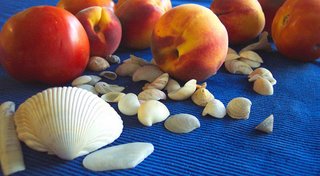
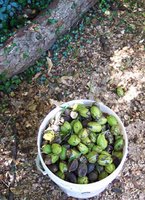 Since we came home, instead of leaning over to pick up seashells on the beach, I’ve been picking up pecans by the bucketful from the ground under the pecan trees. Some nuts were undeveloped, shed by the trees in response to the drought, some were bitten, half-eaten and thrown around by the squirrels. I don’t think the trees themselves are in danger, since the leaves are green. These trees did the same thing last September - in the middle of the night we were wakened over and over by a hearing a thunk on the roof, followed by a rolling sound, then a thud as the nut hit the ground. It was unnerving at first, but it eventually became one of those comfortable, usual, recognizable sounds – your brain just says, ‘Pecan falling’ and lets you stay sleep.
  ... Both lilies grew for years in large deck pots, where they developed into multiple bulbs. Once we moved here, the bulbs were planted in the ground, but the tags were lost and the individual bulbs were mixed up. Whatever the name, I'm thrilled to see it bloom!


 Although I'm far away from my family and many of those people are no longer around to celebrate Little Christmas, the lights will shine here for a few more nights, to puzzle the neighbors and add a little sparkle to the January darkness.
  A .. birthday gift from my mother and sisters was a miniature rose bush... I divided it into 3 plants last spring and one of them was still blooming yesterday near the shelter of a brick wall.
  The Sasanqua camellia 'Shishi Gashira' seems untroubled by the colder weather - with just a few more buds not yet opened.
  Inside the house the barely budded Thanksgiving cactus from the previous Blooms Day post had opened in the hoped for peachy-apricot color, which I like very much in the breakfast room.
 - my reward was a few delicate flowers in that shade... but they didn't appear on the usual 3-foot stalk. The plant was already taller than usual when I brought it in and it kept elongating all of December.
  Now the flowers hang almost at eye level, 58 inches above the surface of the potting soil.